
or: How I Learned to Stop Worrying and Love the Battery
The sky above City B-11 was the colour of television, tuned to a dead channel. The last three generations would probably not understand that sentence—but T did, even though he was young. He was looking at the same image with his own eyes. Inside his grandfather’s old phone remained encrypted files the Contra-Intelligence had never managed to decode. Books from the twentieth century. He had read many of them—whether to know the grandfather he had long lost, or because they truly intrigued him, no one could say.
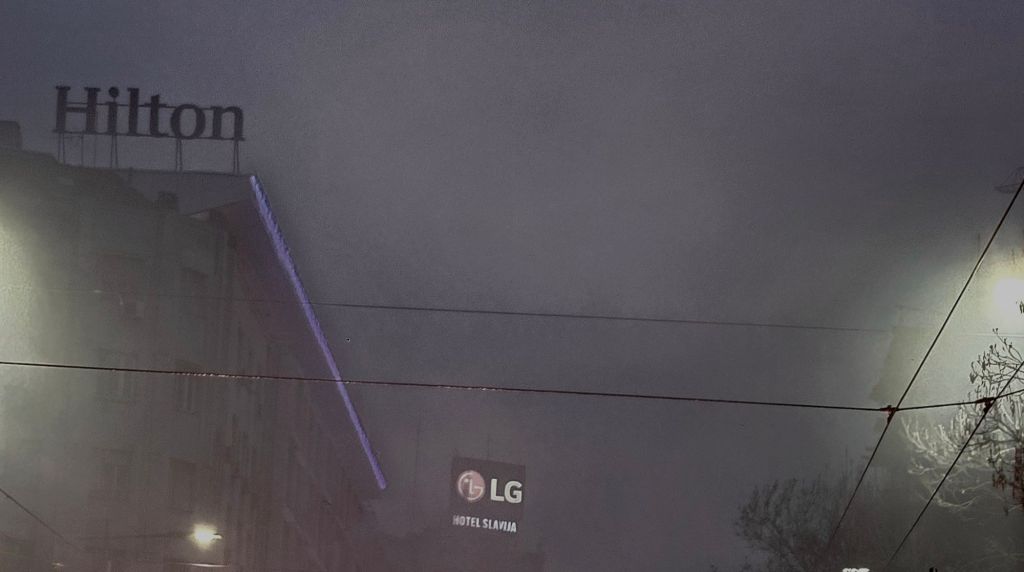
It was almost midnight. Hurrying to catch the last electrobus to the blocks, before the drizzle turned to acid rain, he reached the intersection where a group of people blocked the traffic—grandchildren of former rebels. They demanded justice for sixteen innocents who had perished in a time no longer mentioned. Few knew anything about those unlucky souls. For most, they were just forgotten bodies. Even fewer knew what had really happened. Daily reports of deaths in the eastern and western mining zones had made the people numb to tragedy—and even more to memory.
They carried banners with names and surnames. Back then, people still had names. And surnames. They received them from their parents. Twice a year, on Sunday nights at the end of each fiscal semester, the Contra-Intelligence allowed the intersection to be blocked—for exactly sixteen minutes. T walked past them, head bowed, thinking—despite everything—that he was still in a better position than the workers in zones ZA and BO.
T—technician 36, coal zone KO.
Coal had long ceased to be used in the country. Since the energy system collapsed in the thirties, thermal plants had been shut down and everything switched to batteries. Coal was exported to Southeast Asia, leaving little pressure on technicians. Some of it was smuggled onto the local market for heating, since battery heat was too expensive. That was a chance for T to earn a little extra.
Those from zone JA—lithium—had it the worst. Excavation and purification. After five or six years they were “retired” and replaced by others, though none were ever seen again. No one went there by choice. The Contra-Intelligence managed the redistribution of human resources. He had known a few who’d ended up there. They’d lived near him. Briefly. He never envied them.
A drone tailed him as he left the intersection—standard procedure. The Contra-Intelligence monitored every move, intercepted every message. Working for them was his quiet dream: maybe piloting drones, maybe maintaining their systems—a softer life. But his origin had anchored him to the mining zones. His grandfather had been a dissident. That was something one never escaped. Better T than R, anyway. R went underground. T stayed on the surface. Servicing. Smuggling.
At a kiosk, dinner waited in sealed trays—Argentinian beans in Vietnamese tomato sauce. The drone buzzed away.
The bus stop overflowed. People huddled under the shelter while the acid drizzle thickened into a downpour. His expensive raincoat could last at least half an hour, so he didn’t push his way in. He disliked crowds. Faces glowed in the light of small screens; no one looked at anyone. Each drop of rain sounded clear in his ears. Alone—even among people—he couldn’t exchange a single glance.
The electrobus arrived. The ride to the blocks usually took two hours. Around midnight, when the work groups returned to their sleeping quarters, the bridge—the only one left across the river—was jammed. Finding a seat, he closed his eyes. Wanted a little sleep. Had to get up at five tomorrow. Leaning his head against the wet glass, he watched the blurred towers glowing in the distance, where people from the Contra-Intelligence lived. I could’ve been there, he thought.
His thoughts drifted to his grandfather—the only close being he’d ever had. The books in that old phone were his only inheritance. A forbidden inheritance.
Sleep took him, with his grandfather’s voice still echoing in his head.
He never knew the dream was interrupted—by an explosion. The electrobus burst into flames. Cheap batteries hadn’t lasted even their planned thousand charges. The blaze consumed the vehicle and everything inside. Acid rain washed over the wreckage, dissolving metal and flesh until the water carried the last traces into the drain.
Traffic soon resumed.
 VRTLOG
Postavi komentar